
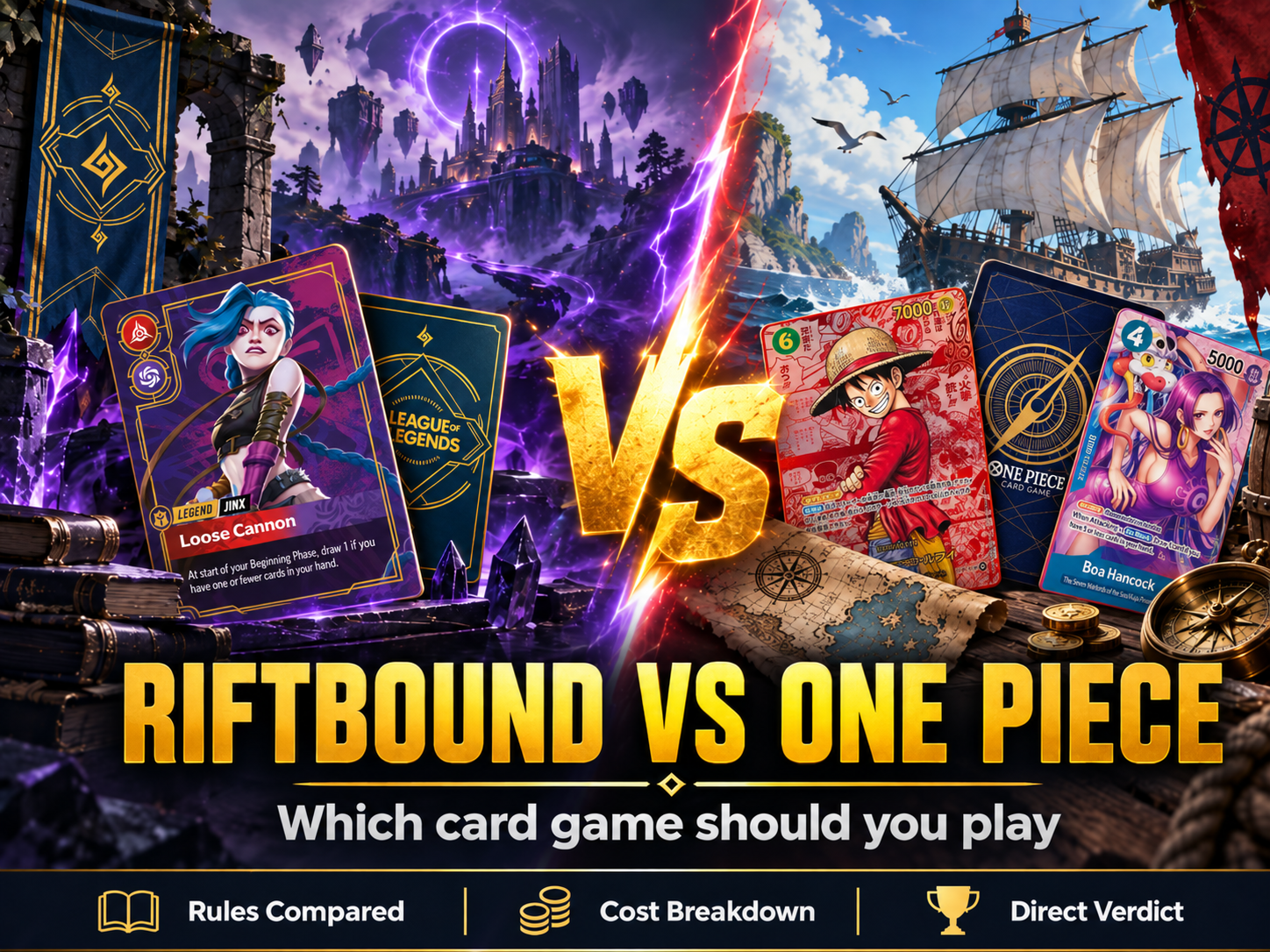
Riftbound vs One Piece comes down to one real question: does Riftbound fix the things that actually bother you about the One Piece Card Game? The short version is yes, in three specific ways, and no, in two others. Riftbound uses a separate resource deck too, so the core structure will feel familiar within your first few games. But the resource system, the combat, and the win condition are different enough that switching is not a small decision. Here is exactly what changes, what carries over, and what it costs to find out.
Page last updated: September 8, 2026.
The Short Answer
If your biggest complaint about One Piece is the April 2026 block rotation turning your competitive cards into casual-only cards overnight, Riftbound solves that specific problem: no rotation is scheduled until 2028. If your complaint is the cost of getting competitive, One Piece is still the cheaper of the two games to build a tournament-ready deck in right now. Riftbound will not replace One Piece for most collectors. It sits well alongside it, and once you get past the opening few turns, the two decks ask almost none of the same skills of you at a mechanical level.
| Category | One Piece | Riftbound |
|---|---|---|
| Resource deck concept | DON!! deck | Rune Deck |
| Deck size | 50 main + 1 Leader + 10 DON!! | 60 main + 1 Legend + 12 Rune Deck |
| Copy limit | 4 of any card | 3 of any card |
| Win condition | Reduce Life cards to zero, then hit the Leader once more | Reach 8 points via Battlefield control |
| Rotation | Active. April 2026 rotated OP-01 through OP-04 | None scheduled until 2028 |
| Competitive entry cost | $80-200 | $150-400 |
How They Actually Play
Both games separate your resources from your main deck, which is the first thing a One Piece player will recognise in Riftbound. It is unusual in trading card games, and it means neither game leaves you drawing your resources and your action cards from the same pile. Past that point, almost everything works differently. If none of the terms below make sense yet, our how to play Riftbound guide walks through a full game from setup to first win.
Deck Construction
One Piece decks are exactly 1 Leader, 50 main deck cards, and 10 DON!! cards, with a maximum of 4 copies of any card and every card matching your Leader’s 1-2 colour identity. Your Life cards come from the top 4-5 cards of your own main deck, placed face-down at the start of the game.
Riftbound decks are 60 cards plus 1 Legend, a 12-card Rune Deck, and a 10-card sideboard, with a maximum of 3 copies of any card. There is no colour restriction the way One Piece has one, though Power costs still control how far you can realistically spread across domains.
Resource System
One Piece’s DON!! system draws you 2 DON!! automatically every turn (1 on your first turn), up to a maximum of 10 in play. You rest DON!! to activate Event cards, or attach them to a Character or your Leader for +1,000 Power during your turn, and attached DON!! return to the field at the start of your next turn. You are never resource-screwed. The ramp is guaranteed every single turn.
Riftbound generates two separate resources from the same runes. Exhausting a rune (tapping it sideways) generates 1 Energy, always colourless. Recycling a rune (sending it to the bottom of your Rune Deck, where it will come back around) generates 1 Power that matches that rune’s domain. You can do both to the same rune in the same turn if you need to. You channel 2 runes per turn, and whatever sits in your Rune Pool clears at the end of it.
The practical difference: DON!! is universal, so it never cares what colours are in your deck. Riftbound’s Power is domain-specific, which is a real deckbuilding constraint DON!! simply does not have.
Turn Structure and Combat
A One Piece turn runs Refresh, Draw, DON!! (draw 2), then your Main Phase, where you play cards and attack. When you attack, you pick an attacker, declare a target (your opponent’s Leader or a rested Character), and your opponent can respond by playing a Counter straight from their hand before damage resolves.
Riftbound runs Ready, Channel, Action (where Showdowns happen), then End. There is no equivalent to playing a Counter mid-attack from your hand. Instead, when units contest a Battlefield, both players make sequential decisions during the Showdown. It is a more structured, more predictable exchange than reacting to a surprise Counter, and a One Piece player used to that Counter timing will need to recalibrate around it.
Win Condition
One Piece ends when you reduce your opponent’s Life cards to zero and then deal one more point of damage to their Leader. Taking damage draws a Life card, and that card can trigger a powerful effect, which means dealing damage is not automatically good for you. It can hand your opponent exactly what they needed.
Riftbound is won by reaching 8 points through Battlefield control, with a Final Point rule requiring your last point to come from an active conquest, not a leftover one. The score is fully visible to both players at all times. There is no equivalent to the swing a Life card trigger creates in One Piece.
The Five Things One Piece Players Complain About (and Whether Riftbound Fixes Them)
These are the five complaints that come up most often from One Piece players. Some of them Riftbound genuinely solves. Others it does not, and one is simply too early to call.
| Complaint | Fixed in Riftbound? | Why |
|---|---|---|
| Block rotation devalues cards overnight | Yes, for now | No Riftbound rotation is scheduled until 2028. The April 2026 One Piece rotation that deprecated OP-01 through OP-04 has no equivalent yet. |
| Counter math during combat | Partially | Showdowns replace the mid-attack Counter with a more structured, sequential exchange. You still need to track your progress toward 8 points, but it is less about split-second Power arithmetic in the moment. |
| Early set scarcity and inflated chase prices | No | Riftbound is itself a new game. Its earliest sets, Proving Grounds and Origins, have already shown the same underprinted, above-MSRP secondary market pattern that hit OP-01 and Manga Rare Luffy. |
| A handful of Leaders dominate the competitive meta | Too early to say | Riftbound’s domain-specific Power costs create a deckbuilding constraint DON!! does not have, which could spread the meta wider over time. Riftbound has not been played at high level long enough yet to confirm this either way. |
| Anime catch-up to understand later characters | Mostly | Riftbound champions come from League of Legends rather than an ongoing story arc, so there is no season count to catch up on before a card makes sense. You do not need League of Legends knowledge to play Riftbound at all. |
What It Costs to Get Competitive
One Piece is cheaper to get into today. A Starter Deck runs $12-15, and a competitive singles build lands between $80 and $200, with the most expensive chase card, the OP-01 Manga Rare Luffy, sitting at $280-350. Riftbound’s Champion Deck is $19.99, and a competitive build runs $150-400. Signature cards can run from $300 up to $3,000 or more, but they are never required to compete. They are a collector chase, not a deckbuilding requirement.
| One Piece | Riftbound | |
|---|---|---|
| Starter or Champion Deck | $12-15 MSRP | $19.99 MSRP |
| Competitive build | $80-200 | $150-400 |
| Most expensive chase card | OP-01 Manga Rare Luffy, $280-350 | Signature cards, $300-3,000+ (never required) |
| Rotation risk to that investment | Active since April 2026 | None scheduled until 2028 |
One Piece’s competitive staples are genuinely cheaper than its own collector chase cards, which is worth remembering if the $280+ Manga Rare price tag is what is putting you off. Riftbound’s higher build cost buys you something One Piece currently cannot promise: the deck you finish building this month is still legal in three years. If you are still working out which Riftbound deck actually matches how you already like to play, our guide on which Riftbound deck to buy first is the place to start.
What You Already Know (And What to Forget)
What Transfers
- The separate resource deck concept. DON!! becomes the Rune Deck
- Leader as your deck’s identity anchor. Leader becomes Legend
- A turn built from distinct, named phases
- Understanding that your resource has a hard cap each turn
- The instinct to hold something back for your opponent’s turn. Counter timing becomes Showdown reactions
What You Need to Unlearn
- Four copies of a card becomes three
- Life card triggers have no Riftbound equivalent
- DON!! attaches to units for +1,000 Power. Riftbound Power comes from recycling a rune, not attaching anything to your units
- The two-colour Leader restriction loosens considerably, though Power costs still limit how far you can spread
- Damage alone does not win the game. Board control across 8 points does
Should You Switch or Play Both?
Most One Piece players who try Riftbound do not stop playing One Piece. The two games reward different instincts. One Piece rewards reading your opponent’s Counter timing and managing life-card risk. Riftbound rewards long-term board control and sequencing your runes across a full game. If your frustration with One Piece is really about rotation or the shape its competitive meta has settled into, Riftbound is worth the $150-400 entry to find out if it suits you better. If your frustration is genuinely about cost, Riftbound will not fix that. It currently costs more to compete in, not less.
See What’s Available Right Now
Vendetta is Riftbound’s current set and the easiest place to start building a deck today.
Final Verdict
If block rotation is what is souring you on One Piece, Riftbound vs One Piece is not really a close call: play Riftbound alongside your existing collection and keep both. If money is the actual constraint, stay with One Piece for now and come back to Riftbound once you have a full set behind you, because nothing about Riftbound is going anywhere. Either way, you are not choosing wrong. You are choosing which problem you would rather deal with: a rotating card pool, or a higher price of entry.
OTHER READING
- Read the comparison: Riftbound vs Yu-Gi-Oh
- Read the comparison: Riftbound vs Pokemon, Which TCG Is Better for Beginners
- Read the comparison: Riftbound vs Magic: The Gathering