
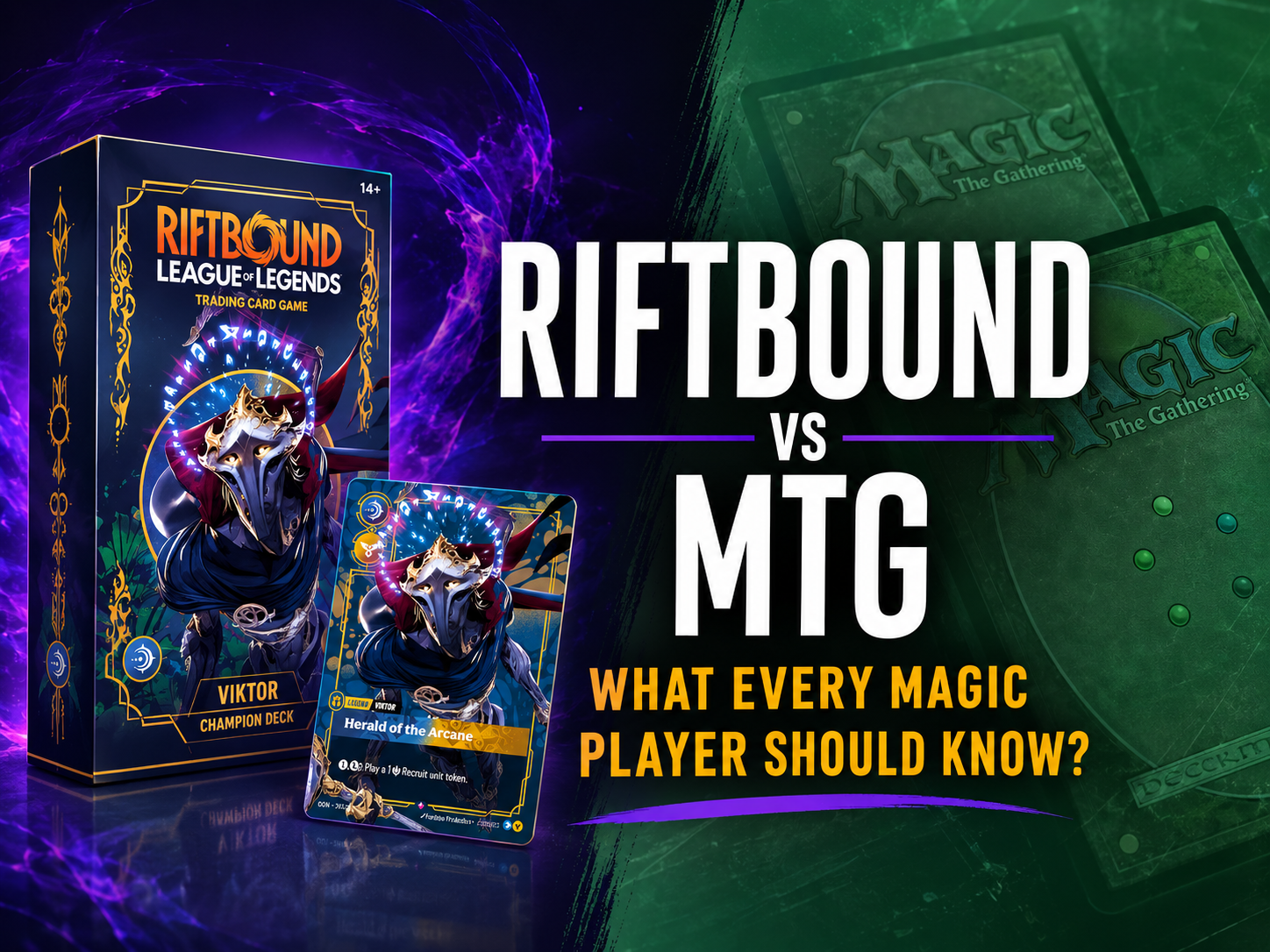
If you play Magic: The Gathering and keep hearing about Riftbound, you probably know the feeling: curious enough to look it up, sceptical enough to stop yourself caring. You have put real time and money into Magic. The last thing you need is someone pushing another card game on you. This is not that. It is a direct comparison written for MTG players who want an honest read on whether Riftbound is genuinely different or just familiar mechanics with a League of Legends skin.
Page last updated: 9 May 2026. Prices and card details reflect the Unleashed (Set 3) launch window.
What Your MTG Knowledge Gets You
The first thing most MTG players notice when they sit down with Riftbound is how familiar the structure feels. Cards fit into clear categories. There are units you deploy to the board, spells you cast for immediate effect, gear you attach to units, and runes that provide resources. If you have spent any time with creatures, instants, artifacts, and lands, you already understand roughly what each card type is trying to do.
The turn structure is also familiar territory. You have a draw step, a main phase where you play cards from hand, and a combat phase where units attack and defend. Priority passes back and forth. You can respond to certain actions. None of this requires re-learning from scratch. Most MTG players are functional within a single game, not a single session.
| MTG Concept | Riftbound Equivalent | How Similar |
|---|---|---|
| Creature | Unit | Very similar. Deploy to board, attack, block, use abilities. |
| Instant / Sorcery | Spell | Similar. Immediate effects. Some have timing restrictions like instants. |
| Artifact / Equipment | Gear | Close match. Attach to units to boost them. |
| Mana / Lands | Rune | Both are the resource currency you spend to play cards. Source is different: MTG mana comes from lands on the battlefield; Riftbound runes come from a separate deck. |
| Commander / General | Champion | Named character central to the deck, with a levelling mechanic. |
Combat math will also feel instinctive. You are still looking at attack and defence values, asking whether a trade is worth making, and deciding which units to commit. The vocabulary is slightly different but the underlying decisions are the same ones you have been making for years.
What Is Genuinely Different
Riftbound is not MTG with a League of Legends skin. There are three meaningful differences that change how the game feels at a fundamental level, not just cosmetically.
Might Replaces Power and Toughness
In MTG, each creature has two numbers: power (how much damage it deals) and toughness (how much damage it can absorb). In Riftbound, units have a single stat called Might. Might handles both attacking and defending. A unit with 3 Might deals 3 damage in combat and can absorb 3 damage before being defeated.
This is simpler. It also means combat math works differently. In MTG, a 2/4 blocking a 3/2 survives because its toughness exceeds the attacker’s power. In Riftbound, a unit with 3 Might racing a unit with 3 Might results in both being defeated simultaneously. You lose some granularity, but you gain speed and clarity. Whether you prefer this comes down to taste, not which is objectively better.
One confirmed rule worth knowing: excess damage carries over between units. A unit with high Might can defeat several lower-Might units in a single combat sequence. This rewards aggressive board management in ways that MTG combat sometimes does not.
No Mana Screw: The Rune System
This one will either delight you or feel slightly strange, depending on how much of your MTG identity is built around land sequencing.
In Riftbound, runes are not in your main deck. They sit in a separate 10-card rune deck alongside your champion card. At the start of each turn, you draw two resources automatically: one card from your main deck and one rune from your rune deck. You always have resources. You cannot flood. You cannot be mana screwed.
For MTG players who have lost games to drawing seven lands in a row, this is a genuine relief. For MTG players whose game identity involves tight mana construction and knowing exactly when to take a land versus a spell, there is an adjustment. Deck construction shifts away from mana base optimisation toward card selection and curve management. Both are valid games. They are different games.
The Win Condition Is Area Control, Not Life Points
This is the biggest structural difference. In MTG, you win by reducing your opponent to zero life. In Riftbound, you win by accumulating 8 points. Points come primarily from controlling regions of the board, called Zones, at the end of your turn.
The closest comparison in the wider TCG landscape is Lorcana’s Lore system, where both players race to a point total rather than trying to destroy the opponent directly. This shifts the game from aggression-focused to positional. You are asking different questions: not just “can I attack for lethal?” but “which zones do I need to hold, and which do I contest?”
If you enjoy Commander politics and resource management over pure aggression, this will click immediately. If you primarily play burn or aggressive strategies in MTG, the adjustment is a little larger, but the positional puzzle is genuinely interesting once it lands.
The Cost Comparison: Is It Worth Trying?
MTG’s entry cost in 2026 ranges from around $15 for a preconstructed intro deck to $50 or more for a Commander precon, and significantly higher for anything competitive. Singles for a functional Modern or Legacy deck run into the hundreds.
One Riftbound champion deck is approximately $20. That is the full prebuilt deck for a named champion, ready to play out of the box. You get a complete 60-card main deck, a rune deck, a champion card, and enough to play a full game against a second player who has their own deck.
At that entry point, the risk calculation is straightforward. You are not committing to a collection. You are not buying into a format. You are spending the equivalent of a draft entry fee to find out whether the game clicks for you. The seven champion decks currently available across the three released sets give you real choice about which playstyle to start with.
The honest caveat: Riftbound has a smaller card pool than MTG. It launched in 2025 and has three sets as of May 2026. The depth you get from 30 years of MTG card history is not here yet. The counterpoint is that this is also the most accessible the game will ever be. Learning the format now means you are building knowledge alongside the card pool rather than trying to catch up to it.
One champion deck, at $20, is genuinely low-risk for an MTG player. If you dislike it after three games, you have spent less than a Commander precon and learned something useful about your own preferences.
Quick Reference: Riftbound vs MTG
| Feature | Magic: The Gathering | Riftbound |
|---|---|---|
| Combat stats | Power and toughness (two numbers) | Might (single number) |
| Resource system | Lands in main deck, draw variance | Rune deck, two guaranteed per turn |
| Win condition | Reduce opponent to 0 life | Reach 8 points via zone control |
| Entry cost (prebuilt) | $15 intro / $50+ Commander precon | Approximately $20 champion deck |
| Card pool size | Very large (30+ years of sets) | Smaller but growing (3 sets, May 2026) |
| Format complexity | Multiple formats with different legality rules | Single format, one deck per player |
| Learning curve | High for new players | Lower, especially if you already know MTG |
Final Verdict
If you are an MTG player who is curious but sceptical, here is the direct answer: try it. One deck, $20, and your existing card game knowledge makes the learning curve nearly flat.
Riftbound is not MTG and it is not trying to be. The rune system removes mana variance entirely, which is a meaningful design choice rather than an oversight. The Might stat simplifies combat without making it shallow. The zone-control win condition asks a different positional question than reducing life totals. These are genuine differences, not deficiencies.
The honest risk is the card pool. You are playing a game that launched in 2025 with three sets available. There is less strategic depth right now than in a mature TCG. If maximum deck diversity and format complexity are what you love about MTG, Riftbound will feel limited for now. That changes with every set release, and Vendetta arrives in July 2026.
If you want a game that you can sit down and play competently in one session, that does not punish you for not owning 500 singles, and that costs less than a Commander precon to try properly: one champion deck is the right starting point. Pick the champion whose playstyle sounds most interesting to you and order one deck.
Also comparing with Pokemon? Riftbound vs Pokemon, which is better for beginners.
Stay Ahead of New Releases
Vendetta arrives July 2026 with new champions and mechanics. Sign up and we’ll let you know when new set guides go live.
Not sure which champion to start with?
We put together a full breakdown of every champion deck available, matched to playstyle and budget. If you know how you like to play in MTG, you can find the equivalent starting point in Riftbound.