
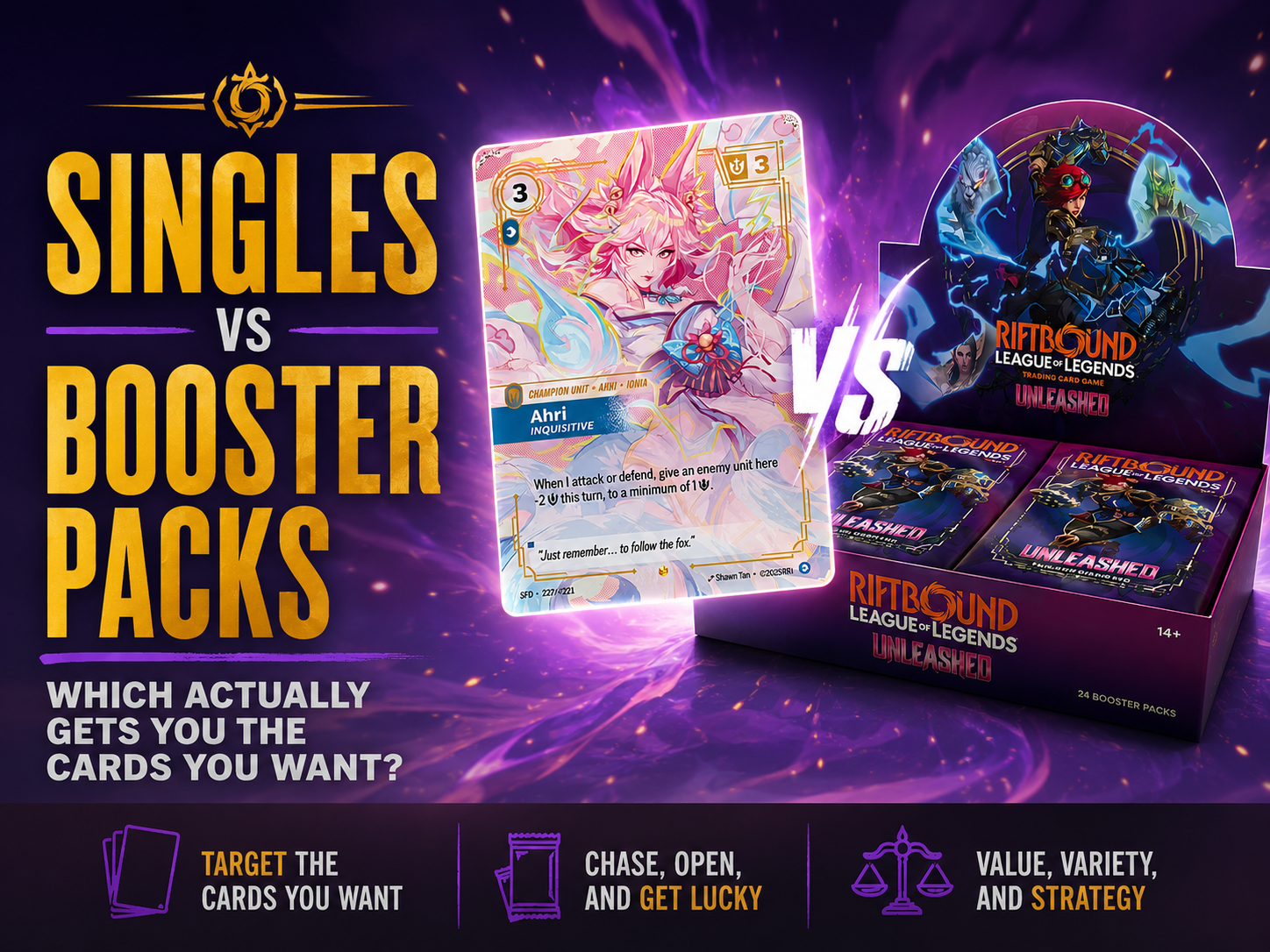
If you’ve been wondering about riftbound singles vs booster packs, here’s the honest answer up front: if you want specific cards to build or upgrade a deck, singles win every time. Packs are for the experience of opening them, not for efficiently getting the cards you want. That’s not a knock on packs, it’s just what they are. Once you understand that, every buying decision becomes easy.
Page last updated: 10 May 2026. Prices reflect TCGPlayer market data as of this date. Baron Nashor single price sourced from RiftDecks.com post-launch data.
Why This Question Comes Up
You’ve picked up a champion deck. You’ve played a few games. Now you’re browsing online and you see booster packs and wonder if you should be cracking some open. Maybe you’re looking for a specific card. Maybe you’ve watched someone on YouTube pull something amazing and thought “that could be me.” Maybe you just want to know whether buying packs is a smart move or a trap.
We went through exactly this thought process when we first started looking at Riftbound. It took us a while to understand what packs actually give you versus what singles give you, so here’s the breakdown we wish we’d had.
What You Actually Get in a Booster Pack
Each Riftbound Unleashed booster pack contains 14 cards. The breakdown is: 7 commons, 3 uncommons, 2 foil rares or better, 1 foil card of any rarity, and 1 token slot. Rares and Epics both come in foil, which means every pack has some visual pop. Champion Legends are Rare rarity, so they can show up in the regular foil slots. You are not chasing an Epic for Champion Legends specifically.
A booster box contains 24 packs at an MSRP of approximately $130, which works out to about $5.42 per pack. That’s the retail baseline. If you’re buying individual packs in a local game store, expect closer to $6 or $7 each.
The Pack Contents at a Glance
| Slot | Cards per Pack | Notes |
|---|---|---|
| Common | 7 | Guaranteed every pack |
| Uncommon | 3 | Guaranteed every pack |
| Foil Rare or better | 2 | Minimum two foil rares per pack |
| Foil (any rarity) | 1 | Could be Common, Uncommon, Rare, or Epic |
| Token | 1 | Token slot, not a playable card |
That’s better than a lot of TCGs on foil density, which is one reason Riftbound packs feel satisfying to open. But looking good in the hand and being efficient for deck building are two different things.
The Pack Maths: What You’re Actually Paying Per Card
Here’s where it gets important. Let’s say you want Baron Nashor, Unleashed’s Ultimate Rare. It’s the chase card of the set, an overnumbered card that appears in fewer than 0.1% of packs. Do the maths: at one per roughly 1,000 packs, you’d need to open approximately 42 booster boxes to expect a single copy. At $130 per box, that’s around $5,400 in product to chase one card.
That same card currently sells for around $74 on the singles market. You could buy one today for $74 instead of gambling $5,400 for a statistical chance at pulling it. There is no version of that maths that makes pack cracking a sensible strategy for getting a specific card.
The trap that gets people: you crack a pack, pull something exciting, and think “this is working.” That’s survivorship bias. For every lucky pull, dozens of packs contained nothing you needed. The singles market is where all those pulled-and-unwanted cards end up, at a fraction of what the opener paid.
Singles vs Packs: A Direct Comparison
| Goal | Pack Route | Singles Route | Winner |
|---|---|---|---|
| Get Baron Nashor | ~$5,400 expected spend | ~$74 on TCGPlayer | Singles |
| Get specific Rare cards | Random, no guarantee | Buy exact card, exact price | Singles |
| Get a selection of cards to play limited | Open packs, play what you pull | Not applicable for limited | Packs |
| Experience opening new packs | Exactly what packs are for | No opening experience | Packs |
| Collect alt-art showcase cards | Low probability per pack | Buy exact variant directly | Singles |
| Get specific Commons or Uncommons | Possible but wasteful | Usually $0.50 or less each | Singles |
The pattern is clear. Any time you have a specific card in mind, singles win. The only time packs win is when you want the experience of opening packs itself.
Want the full pull rate breakdown? Riftbound rarity guide. Pull rates and what each rarity means.
When Packs Actually Make Sense
We want to be fair about this, because packs are genuinely good for certain things. Here’s when buying packs is a reasonable choice.
Draft and Limited Events
Pre-Rift events and limited format play require sealed product. You’re given packs, you open them, and you build a deck from what you pull. In this format, you’re not chasing specific cards, you’re playing with what you get. This is actually a great way to try Riftbound without needing to know what you want to build. The packs aren’t a value play here, they’re the entry format.
The Opening Experience
Some people enjoy opening packs. That’s a real thing. The foil on every Rare, the possibility of something unexpected, the ritual of it. If cracking packs is something you genuinely enjoy and you’ve set aside a budget for it, that’s a legitimate reason to buy a box. Just go in knowing you’re paying for the experience, not for efficient card acquisition. Budget it like entertainment, not like investment.
Collecting Alt-Arts and Showcase Cards
Unleashed has 30+ alternate art variants. If you’re a collector who wants specific showcase versions of cards, the singles market for alt-arts is your best bet. But if you enjoy hunting through packs for them, that’s also valid as a collector’s approach. Again: entertainment budget, not deck-building budget.
Sealed Product as an Investment
This is only relevant if you’re thinking long-term and are happy to leave boxes untouched. Riftbound sealed product has historically held and gained value. Origins booster boxes launched at around $80 and now sell for over $200. Spiritforged launched at $130 and sits around $185 today. If Unleashed follows the same pattern, a sealed box bought at MSRP now could be worth more in a year or two.
We’d call this a collector angle, not a beginner strategy. You’d need to buy the box, resist opening it, store it properly, and wait. For most people reading this, that’s not the goal. See our Unleashed Products Buying Guide for the full breakdown of what’s available and where to buy at MSRP.
When Singles Make Sense
Almost always, if your goal involves getting specific cards.
Upgrading a Champion Deck
Most champion deck guides, including our guides to the Vi and Vex decks, include an upgrades table with the exact cards worth adding. Those cards have real prices on TCGPlayer. A typical champion deck upgrade might cost $15 to $40 in singles for meaningful improvements. If you bought packs trying to hit those same cards, you could easily spend ten times that and still not pull everything you need.
Building a Specific Deck
If you’ve found a deck list you want to build, singles are the only sensible route. You know exactly what you need, you can see exactly what each card costs, and you pay for what you want. TCGPlayer’s marketplace means multiple sellers compete on price, which keeps costs low. The cards you’re pulling from packs that you don’t need are being sold by other people at prices that reflect what they’re actually worth, which is usually less than you paid to pull them.
Commons and Uncommons
This is one we didn’t think about at first: Commons and Uncommons are often the backbone of deck upgrades, and they’re nearly free on the singles market. A Common that supports your strategy might cost $0.50. An Uncommon might be $1 or $2. You’d need to open a lot of packs to guarantee specific ones, and when you did pull them, you’d have duplicates you don’t need. Just buy them individually. It costs almost nothing.
If you’re looking to browse what’s available right now, TCGPlayer is the right place. Multiple sellers, competitive prices, and you can filter by set to see exactly what Unleashed singles look like post-launch.
What the Secondary Market Tells Us
Here’s something that clicked for us: every card that someone pulls from a booster pack and doesn’t need ends up on the singles market. The singles market is the surplus from pack openings. When you buy a single, you’re buying a card that someone else pulled and didn’t want. You’re paying a fair price for a specific card, and they’re recouping some of what they spent on packs.
The existence of a healthy singles market means pack economics are already baked in. The market knows how rare each card is, it knows how many packs are being opened, and it prices cards accordingly. You benefit from that information by just buying the card you want instead of trying to beat the odds yourself.
New sets take a few weeks to stabilise in price after launch. Very sought-after cards spike immediately. Cards that turn out to be less useful than expected drop. If you can wait two or three weeks after a set launches before buying singles, you often get better prices as the market settles.
Final Verdict: Builder or Opener?
If you want to build or upgrade a deck, buy singles. That applies whether you’re adding two cards to a champion deck or building something from scratch. You’ll spend less, you’ll get exactly what you need, and you won’t be sitting on a pile of cards you don’t have a plan for.
If you want the experience of opening packs, cracking a box with a friend, seeing what you pull, and enjoying the foil cards across the table, go ahead and buy packs. Set a budget you’re comfortable with, enjoy the opening, and treat it like entertainment rather than efficient card acquisition. You might pull something useful. You might not. Either way, you got what you paid for.
The mistake is buying packs when you actually want specific cards. That’s where money disappears without getting you where you want to go. Pick your lane and you won’t have buyer’s regret either way.
Ready to build? TCGPlayer is where we always start. You can filter by set, sort by price, and compare sellers all in one place.
Where to Buy
For singles, TCGPlayer is the best option. Multiple sellers compete on price, stock is usually solid, and you can find everything from Commons at $0.50 to chase Rares in one place. Use the link below to browse Unleashed singles directly. For booster boxes, Amazon is a reliable option for sealed product at or near MSRP. Check both stores as stock varies.
Still deciding which champion deck to start with?
Our full deck comparison guide covers every champion deck available and tells you which one fits your playstyle. If you haven’t committed to a deck yet, that’s the right place to start before buying any singles.
Ready to upgrade your deck with singles? How to upgrade your Riftbound champion deck.
Get Notified When New Guides Drop
We’ll let you know when new Riftbound sets arrive and when new buying guides and deck guides go live.
More from RiftboundGuide
- Unleashed Products Buying Guide. Everything available for the new set and where to get it at a fair price
- Which Riftbound Deck Should I Buy First? If you’re still deciding on your first champion deck