
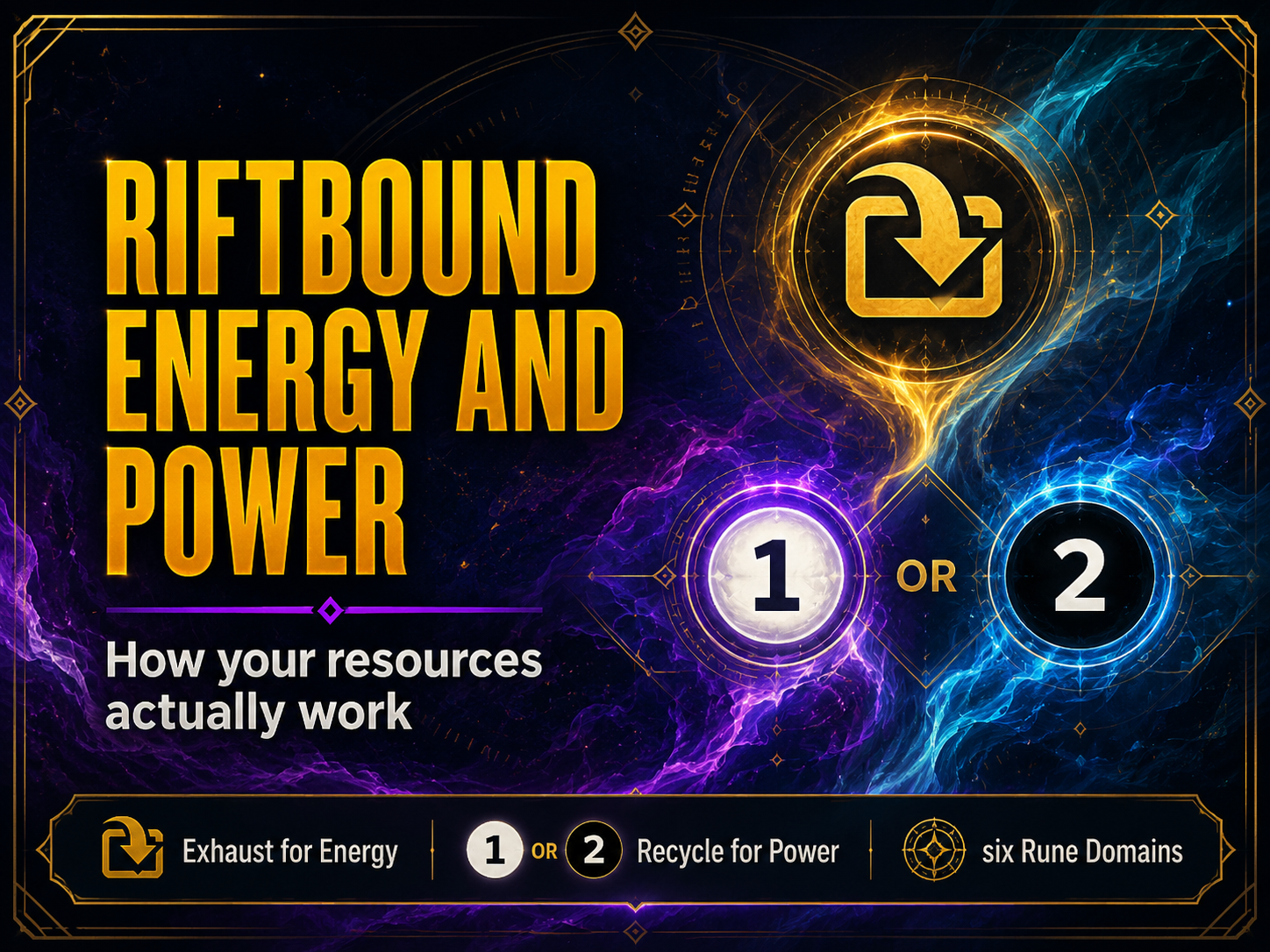
The Riftbound energy power difference is simple once you see it: Energy comes from exhausting a rune, and Power comes from recycling one. They are two separate actions rather than two options for the same action, and mixing that up is the single most common source of confusion for new players. This guide breaks down exactly how each resource works so that distinction stops being a guessing game.
Page last updated: August 29, 2026.
Energy and Power both come from your Rune Deck, but they are generated in different ways and spent on different things. This guide covers where they come from, exactly how each one is generated, and what happens to them when your turn ends.
The Rune Deck: Where Resources Come From
Every Riftbound deck includes a separate Rune Deck alongside your 40 card Main Deck. It is not part of the cards you draw during the game, and you never see it as a normal hand card.
The Rune Deck is made up of Domain cards. There are seven Domains in total: Body, Mind, Calm, Fury, Chaos, Order, and Wild.
Your Legend’s Domain Identity decides which Domains you can include in both your Main Deck and your Rune Deck. The Domains Explained guide covers what that means for deck building in more depth than we need here.
What matters for this article is simpler: every rune on the board belongs to a Domain, and that Domain decides what kind of Power it can produce.
Channeling: How You Get Runes Each Turn
At the start of every turn, you channel 2 runes automatically. That means taking the top 2 cards of your Rune Deck and placing them on the board, ready to use.
You do not choose which runes you channel. They come off the top of the deck in order, which is part of why building your Rune Deck around the right Domains matters so much.
Some cards let you channel additional runes beyond the automatic 2, which is one of the main ways decks accelerate their resources. Ornn’s Reaction ability is a good example of resource generation outside the normal channeling flow: it lets him generate Power for gear plays without exhausting or recycling a rune at all. The Ornn champion deck guide walks through how that fits into a full deck plan.
Energy vs Power: What Is the Difference?
Energy is colourless. Any rune on the board can generate Energy regardless of its Domain, and it pays for the plain number you see on a card’s cost.
Power is Domain specific. It can only come from a rune that matches the coloured Domain symbol on the card you are trying to play. If you want a visual reference for exactly what these symbols look like on a real card, RiftboundSymbols.com’s icon reference is worth bookmarking.
Here is the part that trips up almost every beginner: exhausting and recycling are not two options you choose between. They are two separate abilities, and every basic rune has both of them.
Worked example: Say you have one Calm rune already on the board, and your card costs 2 Energy plus 1 Calm Power.
Exhaust the Calm rune: that adds 1 Energy. Exhaust a second rune of any Domain: that adds a second Energy, meeting the card’s Energy cost.
Now recycle that same Calm rune, even though it is already exhausted: that adds 1 Calm Power, meeting the Power cost. The card can now be played, and the Calm rune goes to the bottom of your Rune Deck.
That last step is the key insight. Exhausting and recycling can both happen to the same rune in the same turn, because they are independent abilities rather than a single choice.
Some cards ask for Power from a specific Domain, so it is worth checking which Domain runes you actually have on the board before committing to a turn that needs several different Power symbols at once.
Exhausting vs Recycling: Two Ways to Generate Resources
Exhausting turns a rune sideways. It stays on the board and readies again at the start of your next turn, generating 1 Energy every time you use it this way.
Recycling sends a rune to the bottom of your Rune Deck. It generates 1 Power of that rune’s Domain, and while the rune leaves the board immediately, it is not gone for good.
Recycled runes cycle back through your Rune Deck and will eventually come up to be channeled again. Our full breakdown of how recycling works covers the tempo trade off in more detail if you want to go deeper.
Renekton’s Legend ability leans directly on this combination. His Reaction lets him recycle a rune and spend 2 Wild Power to add 2 Energy, though that Energy can only go toward playing units or activating unit abilities. The Renekton champion deck guide shows how that plays out across a full game.
What Happens to Resources at the End of Your Turn?
Unspent Energy and unspent Power do not carry over. Whatever you have not used disappears when your turn ends, so there is no benefit to holding resources back for later.
Do not bank Energy or Power for later. Whatever you do not spend by the end of your turn is gone. If you already have exactly enough for the card you want to play, there is no downside to spending it right away.
Runes themselves are different from the resources they generate. Any rune still on the board, exhausted or not, readies again at the start of your next turn unless you recycled it.
One more thing that surprises players coming from other card games: Riftbound has no maximum hand size. You keep every card you draw, so there is no discard-to-hand-limit step to worry about at the end of your turn.
Common Resource Mistakes Beginners Make
A few mistakes come up constantly for new players. I made most of these myself in my first few games, especially the recycling one.
- Forgetting to channel your 2 automatic runes at the start of the turn.
- Assuming unspent Energy or Power carries over to your next turn. It does not.
- Treating exhausting and recycling as alternatives instead of two abilities you can use on the same rune.
- Recycling a rune too early, before checking whether you will need that Domain’s Power again later in the game.
- Misreading card costs: the plain number is always Energy, the coloured symbol is always Power.
Putting It All Together
Once you have the Riftbound energy power difference sorted, the rest of the resource system reads a lot faster: exhaust gives you Energy, recycle gives you Power, and you can do both to the same rune in the same turn. A lot of strong plays depend on knowing when that combination is worth it.
If combat and damage are still fuzzy, How Damage Works in Riftbound is the natural next stop, and the How to Play Riftbound hub ties every mechanics guide together in one place.