
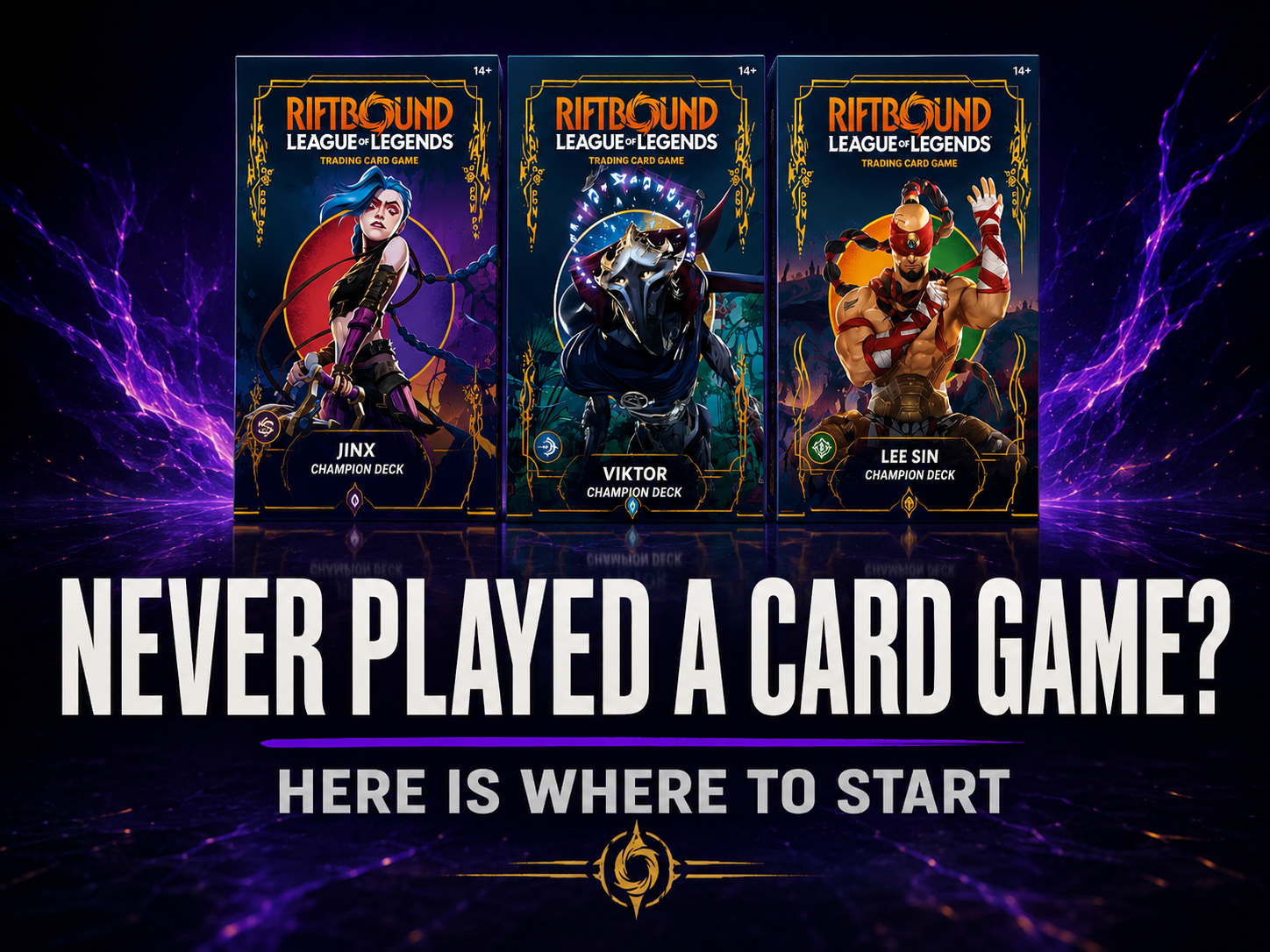
Riftbound for beginners never played card game searches land here for a reason: if you have never picked up a card game and you are wondering whether Riftbound is too complicated to start with, this guide answers that directly. Short answer: it is probably the best card game available right now for someone in exactly your position.
That matters because most card games were not designed for newcomers. They were designed decades ago and have accumulated thirty years of layers, exceptions, and assumed knowledge. Riftbound started from scratch in 2025. It had the luxury of deciding what a new player actually needs to know on day one, and it made different choices because of it.
Not sure whether the League of Legends connection matters?
The short answer is no. Here is why.
Concerns?
The worry most newcomers have is something like: everyone else at the table will know things I do not, and I will feel slow or out of place. That is worth taking seriously. So we will be direct about it: in your first few games of Riftbound, you will be slower than someone who has played before. That is not a knowledge problem. It is a familiarity problem, and it resolves itself by game three or four. Every single person who plays Riftbound went through the same thing.
What you do not need to know
Before we get into what the game is, here is what you can put completely out of your mind.
You do not need to know League of Legends. The champions in Riftbound come from that game, but nothing about LoL carries over. Knowing who Jinx is does not give you any strategic advantage. Not knowing who Jinx is does not put you at a disadvantage. The cards tell you everything about the character you need to know. We wrote a whole separate article on this if you want more detail: Do You Need to Know League of Legends to Play Riftbound?
You do not need to know Magic: The Gathering, Pokemon, or any other card game. None of those mechanics, rules, or habits transfer. There is no equivalent of “tapping”, no energy system, no “the stack”. Riftbound uses its own vocabulary and teaches it to you through the cards themselves.
You do not need to know how to build a deck. Every champion deck comes pre-built and ready to play. You take it out of the box and you are done. Deck building is something you can explore later if it interests you. It is not required to enjoy the game.
What the game actually teaches you as you play
Riftbound is built around a small set of concepts that the game introduces through normal play. Here is what each one means in plain language.
Domains are colour categories. Each card belongs to one or two domains, shown as coloured symbols in the corner. Think of them as the card’s tribe or faction. Most champion decks are built around two domains. You do not need to memorise which colours do what before your first game. The cards tell you.
Might is how strong a unit is in a fight. A unit with 3 Might hits for 3 damage. A unit with 1 Might hits for 1. That is the whole concept. There is no separate attack and defence number to track, just one Might value that does both jobs.
Power is the currency you spend to play cards. Each turn you get Power to spend. A card that costs 2 Power needs 2 of that currency. You spend it to play the card and then your pool refreshes at the start of the next turn. Again, the cards tell you the cost.
Champions are the special characters you build your deck around. They are more powerful than regular units and can level up during the game when you meet certain conditions on the card.
That is most of the vocabulary. There are a few more terms you will pick up in your first game, but they follow the same pattern: the card explains itself. If a card does something special, it says what it does in ordinary language.
The one genuine challenge for a complete newcomer
We said Riftbound is a good starting point, and it is. But we also said we would be honest about challenges, so here is the real one: reading cards fluently takes a few games.
Each card has several pieces of information on it. When you are new, your eyes do not yet know where to look first. You will pick up a card, read it, and not quite be sure what it does in the current situation. That is normal. It happens to everyone. It does not mean you are bad at the game or that card games are not for you. It means your brain has not yet built the habit of reading cards quickly, and that habit forms over the course of a few games without any effort on your part.
By your second or third game, you will find that cards you saw in your first game are now immediately familiar. By your fifth game, most of your deck will feel like old friends. This curve exists in every card game, but in Riftbound it is shorter than average because the card pool is smaller and the language is plainer.
Why Riftbound is a better starting point than Magic or Pokemon
Magic: The Gathering has been running since 1993. That means there are thousands upon thousands of cards, years of community shorthand, and a rulebook that has been patched and revised so many times that even experienced players occasionally disagree on edge cases. It is a brilliant game. It is not the right first game.
Pokemon TCG is simpler than Magic, but it comes with its own years of accumulated design. Some of the core mechanics, like how energy works and how Prizes function, take genuine time to learn because they were designed before anyone thought too hard about new player onboarding.
Riftbound was released in 2025. It had the rare advantage of being able to look at thirty years of card game design, see what confused new players most often, and deliberately avoid those choices. The card pool is smaller, so there is less to learn. The mechanics are named and described on the cards themselves, so you are not relying on outside knowledge. The champion decks are self-contained, so you can sit down and play without preparation.
That is what makes Riftbound for beginners with no card game experience the better entry point: you are learning the real game, not a simplified version of it.
Your first three games will feel slow, and that is completely fine
Picture learning to drive for the first time. Every action that an experienced driver does without thinking, you have to think through: check the mirror, indicate, move to the lane, check again. It feels awkward and slow and slightly overwhelming. Six months later, you do all of that without noticing.
The first few games of Riftbound work the same way. You will read cards more slowly than you will in a month. You will forget rules and have to look them up. You will make plays that turn out to be mistakes, and you will not fully understand why until after the game. All of this is the game working exactly as intended. You are not failing. You are learning.
The specific thing worth knowing: your first game will probably take longer than the box says it should. That is because you are reading everything carefully, which is the right thing to do. Do not treat that as a sign that the game is too complicated. Treat it as the first game of something that will feel completely natural soon.
When you are ready to sit down and actually play your first game, our step-by-step guide walks through the whole thing: How to Play Your First Game of Riftbound.
Final Verdict
If you have never played a card game before and you are thinking about starting, Riftbound is the one to pick. Not because it is easy, but because it was designed with you in mind. No prior knowledge required. No inherited complexity from thirty years of design decisions. A smaller card pool that is genuinely learnable. Champion decks that are ready to play out of the box.
The anxiety you feel about not knowing the language is the right feeling to take to Riftbound specifically, because Riftbound is the game that was built to answer it. Pick a champion whose art appeals to you. Buy their deck. Play your first game slowly. You will be fine.
Once you have your first deck, this step-by-step first game walkthrough will get you playing the same day.
Which Deck Should You Start With?
If you are ready to pick your first deck, the honest advice is this: look at the champion art, read the one-line description on the product page, and go with whoever catches your attention. At this stage, picking a champion you find interesting is the whole decision. There is no wrong answer.
You can browse all available champion decks on TCGPlayer. Whichever one catches your eye is the right one to start with. Amazon carries them too if you prefer:
If you want help choosing between specific decks, our guide walks through all of them side by side: Which Riftbound Deck Should I Buy First?
Stay up to date with Riftbound
New sets, new champions, and new buying guides. Sign up and we will keep you posted.